OEC at Submarine Networks World 2026: Making the case for a second life for retired subsea cables
Date
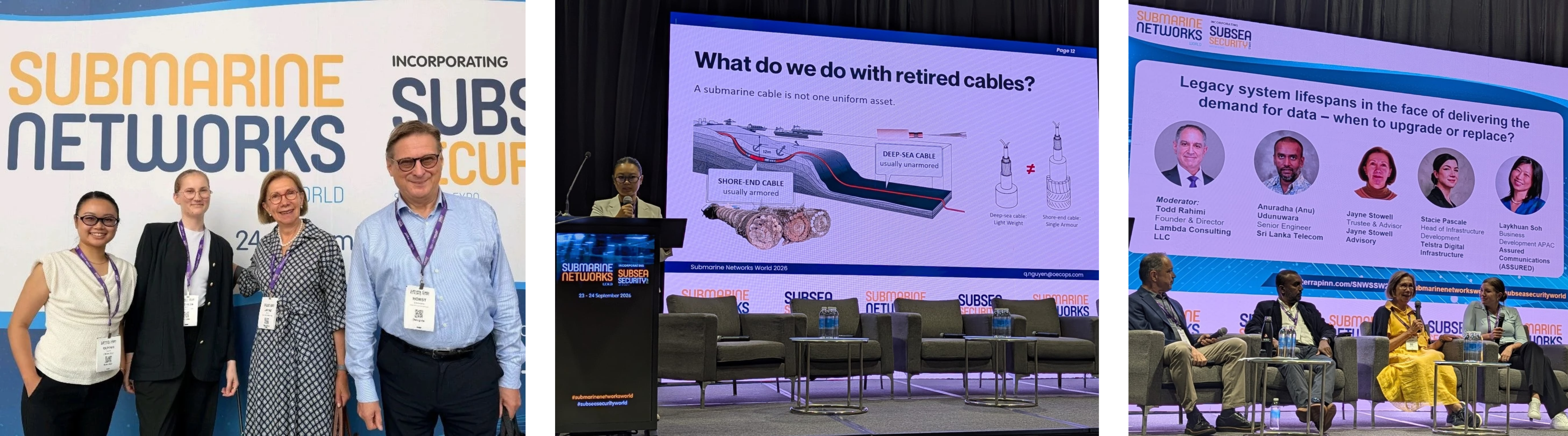
On 23 and 24 September 2026, the Oceanic Environmental Cables (OEC) team was in Singapore for Submarine Networks World, held at the Sands Expo and Convention Centre. It is one of the main meeting points for the global subsea cable industry. Over two days, we met partners, followed discussions on the future of subsea infrastructure, and spoke on stage twice about something close to our hearts: what happens to cables once they leave service.
Recover, Recycle, Repurpose: Quynh Nguyen on the reincarnation of retired subsea cables
On Day 2, our Lead Environmental Officer Quynh Nguyen, winner of the 2025 ESCA NextGen Environmental Awareness Award, presented in the Network track.
She started with the scale of the issue. More than 3.7 million kilometres of cable have been laid on the seabed since the 1850s, and about two-thirds of that length is now out of service. Only around 5% of out-of-service cable has been recovered. The rest is still on the seabed. Meanwhile, more than 100,000 km of new cable are laid every year. The problem is not a lack of space but congestion, especially at busy hubs like the Trans-Atlantic, the Mediterranean and Singapore itself. That congestion affects routing, resilience and the use of resources.
Quynh then compared the three end-of-life options: leaving cables in situ, reusing or repurposing them, and recovering and recycling them. She stressed that a cable is not a uniform asset. Deep-sea and shore-end sections face very different environmental and economic realities, so there is no one-size-fits-all answer. Recycling is still the most viable long-term route to circularity.
She closed with the three recurring barriers and how to address them. On information, the industry needs better data on cable location, ownership, type and condition. On budget, decommissioning should be planned and funded at the project design stage. On coordination, cable owners, manufacturers, recyclers and regulators need to work more closely together, with clearer permitting. Her message was urgent: between 2026 and 2040, the industry is expected to lay 1.6 million km of new cable and retire 845,000 km.
Legacy systems: upgrade or replace? Jayne Stowell on the panel
Later that afternoon, our Chairman Jayne Stowell joined Anuradha (Anu) Udunuwara (Sri Lanka Telecom), Lay Khuan Soh and Stacie Pascale (Telstra) on a panel moderated by Todd Rahimi. The topic was when to extend the life of legacy systems and when to replace them.
Jayne framed the decision in three parts:
Technical and operational: ageing components such as repeater laser diodes, and dwindling spares and know-how for old equipment.
Commercial: the point where operating and maintenance costs match or exceed what a cable can earn, and the diminishing returns of further upgrades.
Regulatory and spatial: out-of-service cables increasingly come with costs and obligations. Old systems also occupy some of the best routes, which new cables then cannot use.
Her advice to owners was to find out what their legacy cable might be worth to a recycler. Removing deep-sea sections can free a good, safe route for the next generation of systems. Drawing on her long career, she also noted that new technology and competition can make a cable redundant almost overnight. With AI driving demand, that pace of change will only accelerate.
A programme full of end-of-life questions
Several other sessions on the programme addressed issues closely connected to subsea cable recovery and recycling. The Global Projects Showcase highlighted how quickly new systems are being planned across the region, which means more cables will be retired and more routes will need to be cleared. Sessions on permitting and on landing cables along congested coastlines touched on two of the main hurdles in recovery projects: the time it takes to obtain permits and the lack of space on busy routes. Discussions on the legal framework for EEZs and international waters reflected the changing rules that will shape how retired cables are handled in the future. Talks on Pacific Island connectivity were a reminder that some retired cables can still be repurposed to connect smaller or remote communities. Together, these sessions showed that the end of a cable’s life is no longer an afterthought. It is becoming part of how the industry plans, builds and operates its networks, a development that lies at the core of OEC’s work.
Thank you, Singapore!
Many thanks to the organisers, the speakers and everyone who stopped by to talk with us. If you would like to know what your retired cables could be worth, or simply continue the conversation, please get in touch.