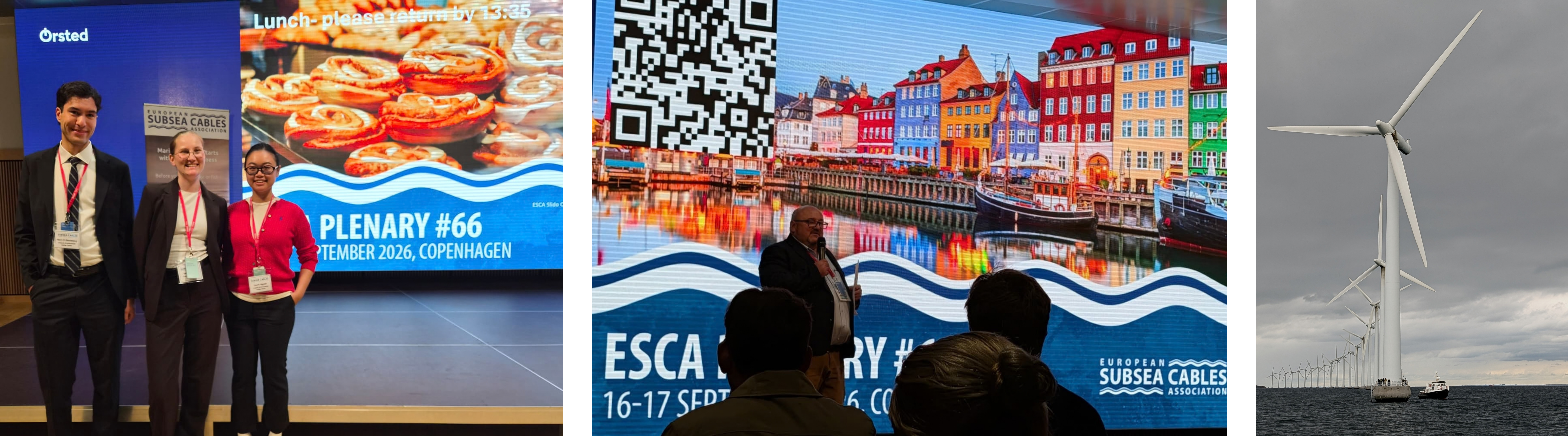
On 16 and 17 September 2026, Quynh D Nguyen, Mathilde Ribes and Henry el Bahnasawy represented OEC at the 66th Plenary of the European Subsea Cables Association (ESCA). This edition was hosted by Ørsted, a global leader in developing, building and operating offshore wind farms. Over two days, the plenary brought together cable owners, operators, contractors, regulators and researchers from across Europe. For our team, it was a valuable opportunity to reconnect with peers and to take part in discussions that sit at the heart of OEC's work in subsea cable recovery and recycling.
Day 1 – Protection, monitoring and decommissioning
The first day opened with a keynote on the security of Europe’s subsea infrastructure, a topic that has moved high up the political agenda in recent years. The morning sessions then focused on protecting cables throughout their lifetime, from route design and burial to new ways of using cables for ocean monitoring.
The afternoon brought the session we were most looking forward to. Around two hours were dedicated to the decommissioning of subsea cables, and several key insights stood out for us.
Recovery has a limited environmental footprint. Removing a cable disturbs the seabed locally during the works, but the overall impact is small. Sites typically recover within about a year, as sediment and marine life return.
Leaving cables in place is not a simple answer. Some suggest retired cables could stay on the seabed for scientific monitoring. This raises an unresolved question of long-term liability once a cable’s owner and operations are gone. Participants called for closer dialogue between operators and regulators on when removal makes the most sense.
Every recovery project needs careful planning. A cable’s condition depends more on its seabed environment and history than on its age. Some decades-old cables come up in excellent shape, while much younger ones can be badly corroded. Thorough preparation before recovery is therefore essential, including planning for storage, since material volumes grow once processed.
Recovered materials have real value. Subsea cables are tough to process, but the copper and other materials they contain are high quality and in demand, making them a genuine resource for the circular economy. The challenge lies in shorter, near-shore sections, which are harder to recover and less economically attractive.
These are exactly the questions OEC works on every day, and it was encouraging to see the industry discussing them so openly.
The day ended with a networking dinner in Copenhagen, a chance to continue the conversations in a more relaxed setting.
Day 2 – Innovation, the next generation and a trip offshore
The second morning looked ahead, with sessions on protecting critical infrastructure, supporting the next generation of subsea professionals, and new technologies such as autonomous inspection, nature-inclusive cable routing and shared cable monitoring. The plenary closed with updates on governance and recent legal developments relevant to the industry.
In the afternoon, our team joined a boat trip to the Middelgrunden offshore wind farm, just off Copenhagen in the Øresund. Denmark has led the way in wind energy for decades and built the world’s very first offshore wind farm. Seeing the turbines from the water was a highlight, as it is only up close that you realise just how big they are. It was a fitting end to two days spent discussing the cables that connect this kind of infrastructure.
See you in Bristol
A big thank you to ESCA for organising such a well-run plenary, and to Ørsted for being an excellent host. We left Copenhagen with new contacts, fresh ideas and a clear sense that decommissioning is rising on the industry’s agenda.
The next ESCA Plenary #67 will take place in Bristol in March 2027. We look forward to seeing you there!